The buying group problem in complex B2B sales is that no single individual owns the decision. Research consistently puts the average buying group at six to ten people, each with different responsibilities, different risk thresholds, and different definitions of what value means in their context. The seller who wins is rarely the one with the best product. It is the one who best understands and navigates the group.
There is a particular kind of silence that experienced sellers recognise. The meeting went well. The contact was engaged, asked the right questions, and said they would take it forward internally. And then nothing. Not a rejection, not a delay with a reason. Just an absence, with the deal neither lost nor won, simply suspended.
Most sellers diagnose this as a follow-up problem or a relationship problem. They were not persistent enough. They did not build sufficient urgency. Those diagnoses are almost always wrong.
The real problem, in most cases, is structural. The person they were selling to was not able to make this decision alone. There were three, five, or eight other people whose views, concerns, and sign-offs needed to be aligned. And the seller had no relationship with any of them, no visibility into their concerns, and no plan for how to help their champion navigate the internal dynamics that would ultimately determine the outcome.
That is not a follow-up problem. It is a buying group problem. And it is one of the most consequential structural challenges in complex B2B selling, which most commercial processes are not designed to address.
01The committee you did not know existed
The structural shift that has made complex B2B selling more difficult over the past two decades is not technology, not greater buyer sophistication, and not the rise of procurement as a professional function. It is the growth of the buying group itself.
Where a purchase decision might once have been made by a single executive with a clear mandate, that same decision now routinely involves a committee. Gartner's research into B2B purchasing behaviour finds that the typical technology purchase involves between six and ten stakeholders. CEB research, published as The Challenger Customer by Matthew Dixon and Brent Adamson, put the average at 5.4 stakeholders for significant B2B decisions and found that groups above that size were materially less likely to reach consensus than smaller groups, not because of disagreement on the outcome, but because of the difficulty of aligning on how to get there. Whichever figure applies to your market, the direction is consistent: more people, more perspectives, more ways for a process to stall before it reaches resolution.
This expansion is not bureaucracy for its own sake. It reflects real organisational logic. As purchase decisions become larger, more consequential, and more difficult to reverse, the risk of being wrong grows. Distributing that risk across a group is rational. So is requiring sign-off from multiple functions when a purchase touches operations, finance, technology, and the people who will actually use what is being bought, all at the same time.
The problem, commercially, is that most sellers are still structured to sell to one person. Their process, their CRM, their preparation methodology, and their instincts are built around a primary contact. When that contact is also the decision-maker, this works. In complex B2B environments, that alignment is increasingly rare. The decision-maker is often someone the seller has never met. The person they spend their time with is an influential stakeholder, a champion, or a process manager, but not the one with final authority or the full picture of what is at stake internally.
Understanding how organisations move through their buying decision is a prerequisite for this kind of commercial work. But the decision journey describes stages. The buying group problem is about the people who navigate those stages, and why the dynamics between them matter as much as the stages themselves.
02The anatomy of a buying group
Not everyone in a buying group has the same role, the same influence, or the same relationship to the outcome. Understanding the structure of a buying group is the precondition for navigating it with any intentionality.
Four roles appear consistently across buying groups in complex B2B environments, though they are distributed differently across different organisation types and deal structures. One person can occupy more than one role. Some roles may have multiple occupants. And the role that matters most is not always the most visible one.
Holds final budget authority and sign-off. Focused on strategic alignment, financial return, and organisational risk. Often less involved in day-to-day evaluation but the decision ultimately passes through them. If they are not bought in, the deal does not close regardless of what everyone else thinks.
Evaluates fit, integration requirements, compliance, and risk. Often found in procurement, IT, legal, or quality functions. Less concerned with the value case than with whether the purchase meets the organisation's standards and whether it can be approved without creating liability or operational disruption.
Will live with the outcome. Frequently underweighted in commercial conversations because they are harder to reach and less visible in the formal process. Capable of derailing late-stage decisions when their concerns were never addressed, and equally capable of becoming the most credible internal advocates when they are genuinely engaged.
The internal advocate who believes a change needs to happen and is willing to invest political capital in making it so. The most important relationship in any complex deal. Often mistaken for the decision-maker because they are the most visible and most engaged. They are not the same thing, and confusing the two is one of the most common reasons deals stall.
What this map reveals, when drawn honestly, is almost always a more complex picture than the seller's CRM reflects. There are people in the group who the seller has never spoken to, roles that are filled but not yet identified, and power dynamics between stakeholders that the primary contact may not fully understand themselves.
Mapping the group is not a one-time exercise. It is a discipline maintained across the life of a deal, updated as new stakeholders surface and as the balance of influence shifts during the evaluation process.
The vote and the veto
Understanding buying group dynamics requires a distinction that most sellers never make: the difference between the authority to approve a decision and the ability to block one.
In most organisational buying processes, there are stakeholders who cannot approve a purchase but can prevent it. Procurement can impose conditions that kill a deal on price or commercial terms long after the value case has been accepted. IT security can surface a compliance concern at the final stage of a process that was otherwise agreed. A finance director who was never consulted can raise a question about budget allocation that freezes the process for a quarter. Legal can introduce a contractual requirement that takes months to resolve.
None of these stakeholders may have appeared in a single meeting. None may be visible in the CRM or referenced in any conversation with the primary contact. But each holds the ability to apply a brake that the seller has no way of releasing, because they never knew the brake existed.
The deal that stalls is rarely lost to the person across the table. It is lost to the person you never met.
This is the silent veto, and it accounts for a significant proportion of late-stage deal failures in complex B2B environments. The seller reaches the point of apparent agreement, the internal process begins, and then the process reveals a requirement or a concern that was never surfaced because nobody thought to involve the relevant stakeholder at the right stage.
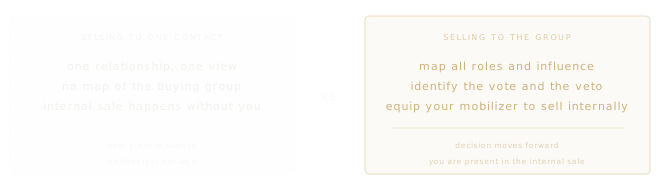
The commercial discipline this requires is specific: identify, early and explicitly, who in this organisation has the ability to block this decision, regardless of whether they have the authority to approve it. Ask your champion directly. Ask what governance or sign-off processes apply. Ask who will need to be comfortable with this decision before it can proceed, including the people who are not typically part of the commercial conversation.
The answers to those questions define the real stakeholder landscape, not the visible one. And building a commercial plan around the real landscape, rather than the visible one, is the difference between a deal that completes and one that stalls two steps from the line.
04The internal sale you cannot see
Every complex B2B deal contains a commercial conversation the seller will never directly observe. It is the exchange that happens after the meeting ends, when the champion carries the argument into the rooms the seller cannot enter, to the stakeholders they have never met, in language the seller did not write.
This is the internal sale. Most sellers treat it as their champion's problem.
It is not. It is theirs.
When a champion advocates internally, they need to be equipped to do it. That means they need a clear and credible articulation of the business case, structured not in the seller's language but in the organisation's. They need prepared answers to the objections that will be raised by the functions whose concerns they know and the seller does not. They need a compelling framing of the cost of staying with the current situation, because that framing is the foundation of every internal approval process that actually succeeds.
What most sellers provide instead is enthusiasm and rapport. They trust that the warmth of their engagement with the champion will translate internally. Sometimes it does. More often it does not, because warmth is not a business case, and a champion who is genuinely committed to a change cannot always articulate that commitment persuasively to a finance director who has never met the seller and has twelve other decisions competing for their attention at the same time.
The commercial implication is specific. Before any deal advances past initial engagement, the seller should be able to answer two questions with confidence: what does my champion need to say to achieve internal alignment, and have I given them everything required to say it? If the answer to either question is uncertain, the deal is not as advanced as it appears in the pipeline.
I have watched this failure mode play out in multiple commercial environments. The seller builds a strong relationship with one contact, invests considerable time in the opportunity, and then reaches a point where the champion says they need to "take it to the team" or "run it by the budget holder." That moment is not the final step in the process. It is the point at which the seller's influence effectively ends, unless they have already done the work to shape what happens next.
Equipping the champion is not a courtesy. It is a commercial strategy.
05Selling to groups, not individuals
The commercial response to the buying group problem is not to identify the "real" decision-maker and concentrate effort there. That approach is as likely to generate resentment among the stakeholders who were excluded as it is to produce agreement. In group buying processes, the person with formal authority rarely makes the decision in isolation. The decision is shaped by the group, and a seller who treats it as a one-person problem will eventually be surprised by the people they did not account for.
The more durable approach is to engage the buying group deliberately. That means mapping who is in it early in the process, understanding what each person is trying to achieve and what they are protecting, identifying who holds blocking power even without approval authority, and building a plan for how the champion will manage the internal dynamics that the seller cannot directly access.
The stakeholder mapping canvas exists precisely for this work: to force a systematic and honest answer to who is in the group, where their interests align or conflict, who is engaged and who is not, and what gaps in coverage currently exist. It converts what is often an informal and incomplete mental model into something explicit and actionable.
This approach also requires a different relationship with time. Selling to a group takes longer than selling to an individual. The temptation is to compress the process, to move toward close before every relevant conversation has happened, because the pipeline pressure is real and the opportunity cost of extended sales cycles is visible. That compression is almost always a mistake. The deal that closes with unresolved concerns among key stakeholders creates operational friction, reduced adoption, and reduced likelihood of renewal or expansion. The deal that closes with genuine alignment across the group creates the opposite. CEB research into group buying dynamics found that deals involving genuine stakeholder consensus on the need for change, not just on the chosen vendor, were significantly more likely to deliver the implementation outcomes that drive renewal and expansion. The commercial cost of skipping that alignment is not visible at signature. It surfaces 12 months later.
There is also a competitive dimension worth naming. In most complex B2B deals, sellers are competing not just against other providers but against the internal option of doing nothing. The buying group's default position is always available: continue with what exists, defer the decision, wait for more certainty. Overcoming that default requires that the group, not just the champion, understands why the cost of staying still is real. That case has to be made across multiple perspectives, not just to the person who is already convinced.
The question that orients the entire approach is deceptively simple: who in this organisation will need to be comfortable with this decision before it can proceed? Answer it completely, map the implications, and build the commercial plan around what you find.
Frequently asked questions
What is a buying committee in B2B sales?
A buying committee or buying group is the set of individuals within a customer organisation who are involved in evaluating and approving a significant purchase decision. In complex B2B environments, this typically includes financial decision-makers, technical evaluators, end users, and procurement representatives. Research consistently puts the average buying group at six to ten people, each with different priorities and different thresholds for what constitutes sufficient justification to proceed.
How many stakeholders are involved in a typical B2B purchase decision?
Research consistently puts the number between six and ten for significant B2B purchases, though it varies by organisation size, deal value, and purchase category. What matters more than the exact number is that the count has grown over the past decade, and that most sellers are still oriented toward selling to one or two primary contacts within a much larger group. That gap is where most late-stage deals are lost.
How do you sell effectively to multiple stakeholders with different priorities?
Start by mapping the group: who is in it, what each person cares about, and who has the ability to block the decision even without the authority to approve it. Then invest in equipping your champion with the tools to manage the internal alignment process you cannot directly observe. Each stakeholder needs information relevant to their specific role and concern, not a single undifferentiated message. The seller who wins complex group decisions is usually the one who treats the internal sale as seriously as the external one.