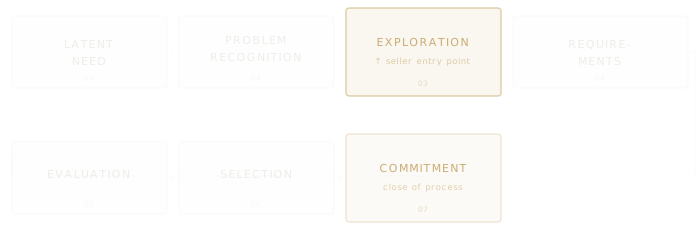
The B2B decision journey is the internal process an organisation follows from first recognising a need to committing to a solution. It moves through stages including problem recognition, exploration, requirements setting, evaluation, and selection, each with its own logic and its own degree of openness to external influence.
The meeting was on the calendar. The prospect had agreed to a call, sent over an agenda, and assigned a procurement contact. By any normal measure, this was progress. It was not. The decision had already been made three months earlier, in a conversation the seller was never invited to.
This is the situation most sellers are in, more often than they realise. Not because they lack skill. Not because their solution is inferior. But because they arrived at the wrong point in a process that was already well advanced before they appeared.
Understanding where a buying organisation actually is in its internal decision process, and adjusting your approach accordingly, is one of the most consequential capabilities a commercial professional can develop. It changes what you say, who you target, what questions you ask, and how you allocate your time across a pipeline.
This article introduces the Decision Journey: a map of how organisational buying decisions move through seven stages, and what sellers should do at each one. You can apply it directly using the Decision Journey Canvas.
I know this situation well. In technology and maritime environments, where buying decisions involve multiple layers of technical evaluation, commercial negotiation, and organisational sign-off, the gap between when a decision forms and when a seller is invited in can be substantial. I have been in conversations where the real decision was made months before anyone issued an RFQ. The sellers who won those contracts were not the ones who responded most skillfully to the brief. They were the ones who had been present, with a genuine perspective, while the brief was still being written.
00First, what this is not
The Decision Journey is not Customer Journey Mapping. It is a different tool built for a different purpose: understanding where a buying organisation is in its internal process, and what a seller should do at each stage.
Customer Journey Mapping is a discipline from marketing and customer experience. It asks: what does the customer feel and do at each touchpoint with our brand or product? It is concerned with experience, emotion, friction, and loyalty. It is typically used by CX teams and marketers to reduce attrition and improve satisfaction.
The Decision Journey is a different tool entirely, built for a different purpose.
Maps the customer's experience of interacting with your product or brand. Perspective: the customer's. Used by: CX, marketing. Purpose: reduce friction, improve satisfaction and retention.
Maps how an organisational buying decision moves internally through stages. Perspective: the seller's. Used by: commercial professionals. Purpose: navigate when and how to intervene to shape the outcome.
These two tools address different questions. CJM asks how customers experience you after they arrive. The Decision Journey asks how buying decisions form before you are involved, and what that means for when and how you enter.
Confusing them is more than a semantic error. It leads sellers to optimise for the wrong things: improving presentation quality when the real leverage is in timing, or refining a proposal when the criteria being used to evaluate it were written without seller input.
01Seven stages of an organisational buying decision
Buying decisions in complex B2B environments do not arrive fully formed. They develop through a sequence of internal stages, each with its own logic, its own participants, and its own degree of openness to external influence.
What follows is not a theory. It is a map I have used in practice, in environments where the decisions were complex, the stakeholders were numerous, and the risk of entering at the wrong moment was real and costly.
No active problem is being considered. The organisation is operating within existing arrangements, and no one is looking for change. Sellers who reach buyers at this stage are rare. But those who do carry an enormous advantage: they can introduce the problem before anyone else has defined it.
Something changes. A regulatory shift, a failed system, a new leader with a new agenda, a competitive threat, a budget cycle that forces a review. The organisation becomes aware that something may need to change. Awareness is not yet a project. But the door has opened.
The organisation is actively trying to understand its situation. Internal conversations are happening. The problem is being defined, the scope is being shaped, and the criteria for a solution are being formed. This is where the most consequential decisions are made, and where almost no sellers are present. Sellers who enter here can shape what "good" looks like before anyone else has the chance.
Criteria have been set. An RFQ may have been issued. A formal evaluation process is underway. Multiple vendors are being compared. This is where the majority of sellers first appear, responding to a brief that was written without them. At this point, the organisation believes it knows what it needs. The seller's ability to influence that belief is severely limited.
A preferred option has emerged from the evaluation. Final checks, legal review, negotiation on terms. The buying organisation is completing a process, not reconsidering its direction. Sellers who are not the preferred option at this stage are rarely in a position to recover. Sellers who are the preferred option should be focused on protecting margin and managing risk, not influencing the outcome.
The purchase has been made. The relationship is now operational. Most sellers reduce their engagement at this point, handing off to a delivery or customer success function. This is a mistake. The quality of what happens during implementation shapes every future commercial conversation with that organisation.
The organisation is now evaluating whether the decision was the right one. Were the promised outcomes delivered? Is the relationship performing as expected? Dissatisfaction at this stage creates switching risk. Satisfaction creates the conditions for expansion, renewal, and reference. Sellers who are paying attention here are already preparing for the next Decision Journey.
The entry problem
Most sellers enter at stage four.
By that point, the buying organisation has spent weeks or months developing a view of its situation. It has defined the problem in its own terms. It has decided what category of solution it is looking for. It has often identified, informally, which vendor it finds most credible. The formal evaluation process that follows is partly genuine and partly ritual: a structured way of justifying a conclusion that is largely already forming.
A seller who enters at stage four is not influencing a decision. They are auditioning for a role in a play that has already been cast.
This is not cynicism. It is arithmetic. If the criteria being used to evaluate options were defined by someone else, and if the organisation's mental model of what it needs was built without your input, then the best available outcome is to match what was already decided. You cannot win on insight when the insight has already been formed.
I have watched this arithmetic play out with commercial teams I have worked closely with. A well-qualified opportunity, late stage, strong relationship, good solution fit. And yet the loss is almost inevitable, because the criteria used to evaluate options were set by someone who was not in the room during the conversations that mattered, using a frame built without any seller input. The conversation is professional. The outcome is already determined.
The question is not whether you can win the evaluation. The question is whether you were in the room when the evaluation criteria were written.
The practical consequence is visible in most pipelines. Win rates on late-stage opportunities are stubbornly low. Gartner research on modern B2B buyer behaviour consistently finds that buyers complete the majority of their internal evaluation before engaging any supplier. The seller who enters at stage four is not shaping the decision but responding to one that is already forming. Sellers who respond to RFQs and formal briefs win some and lose many, often on price or on relationships they did not have time to build. The effort invested rarely reflects the returns.
03The Challenger insight: entering at Exploration
The defining advantage of high-performing sellers is not how they respond to briefs. It is that they are present, with a genuine perspective, before briefs are written.
The sellers who consistently outperform have a different pattern. They are present earlier. Not by accident, and not purely through better prospecting. They are present earlier because they have something worth saying before a problem has been fully defined.
At stage three, Exploration, the buying organisation is not yet certain what it needs. It is gathering perspectives, testing hypotheses, trying to build a coherent picture of its situation. This is precisely the moment when a seller with a well-formed point of view about what the problem actually is can change the conversation entirely.
This is the Challenger insight, applied to timing. The ability to teach a customer something about their own situation is not just a technique for running a better meeting. It is a mechanism for entering a decision process at the point where influence is still possible. If your insight arrives at stage four, it is noise. If it arrives at stage three, it can reframe everything that follows.
I have seen this done well in a handful of commercial environments, and it always has the same quality: the seller brings a specific, well-formed perspective on something the customer is facing before the customer has framed it as a problem they need to solve. In maritime technology, that might mean arriving with a view on how a regulatory shift will affect fleet operations before procurement has begun scoping a solution. In construction, it might mean understanding the implications of material cost pressures for a specific project type before the developer has translated that pressure into a requirement. The insight is never generic. It is specific, and it arrives early enough to matter.
Practically, this means that the sellers who win disproportionately are not the ones who respond most effectively to defined briefs. They are the ones who create conversations before briefs exist. Who initiate contact based on a commercial hypothesis about what a specific organisation might be facing. Who bring a perspective on an emerging challenge before the challenge has been formally acknowledged.
That requires more preparation, more industry knowledge, and more commercial courage than responding to an RFQ. Gartner's research on buyer enablement consistently shows that customers who receive high-quality support in navigating their own decision process are more likely to complete a high-quality purchase and experience lower regret. Earlier entry is not just a competitive advantage but a service to the customer. It also produces results that responding to an RFQ never can.
04What the journey changes
When sellers internalise this model, several things shift.
Discovery conversations change character. Rather than asking what the customer wants and then proposing a solution, the seller is trying to understand where the customer is in its own internal process. Is this a problem that is fully defined, or one that is still being explored? Are the criteria already set, or is there genuine openness about what the solution should look like? The answer to those questions determines not just what to say, but whether the timing makes sense at all.
Pipeline management changes. Most commercial teams assess opportunity quality on the basis of budget, authority, need, and timeline. These remain important. But they tell you nothing about where the organisation is in its decision process, or whether a seller's entry point still allows for influence. A well-qualified opportunity at stage four is often less valuable than an early-stage conversation that is not yet qualified at all.
Account prioritisation changes. If entering at stage three requires more investment than responding at stage four, then time and attention must be allocated differently. Not every account can be approached at Exploration. The ones where early entry is worth the investment are the accounts where the seller can bring a perspective that will genuinely change what the organisation believes it needs.
And the relationship with existing accounts changes. Customers who are in the Validation stage of one decision are also, inevitably, moving toward a new Status Quo and eventually a new Trigger. Sellers who are paying attention to the implementation and validation stages are not just protecting existing business. They are positioning themselves to be present at the beginning of the next journey, rather than arriving when the criteria are already written.
In complex, multi-stakeholder environments this last point is easy to underestimate. Organisations in late Validation are often among the warmest commercial conversations available to a seller, and the most tempting to neglect in favour of new prospects. The error is in forgetting that the most valuable position with any account is to already be present, already trusted, and already developing a perspective on what comes next. Early entry into the next Decision Journey does not begin when the next trigger fires. It begins in how you show up during this one.
05The map is not the territory
Buying decisions do not follow the seven stages in a clean sequence. Triggers can arrive mid-process. Evaluation criteria can be reopened. A new stakeholder can appear late and restart conversations that seemed concluded. Organisations skip stages, return to earlier ones, and sometimes reach stage five before anyone has thought carefully about stage three.
The Decision Journey is not a prediction. It is a navigation tool.
Its value is not in telling you exactly where a buying decision is, but in giving you a framework for asking the right questions: where does this organisation appear to be in its internal process? What does that mean for how I should be engaging? Am I trying to shape a problem that is still being defined, or responding to criteria that are already fixed? Is my current investment of time proportional to the influence I can still have?
The sellers who use this kind of map well do not become formulaic. They become more deliberate. They stop assuming that every conversation is the same kind of conversation. They start distinguishing between the moments when influence is high and the moments when the leverage has already shifted to someone else.
That distinction, applied consistently, is one of the most durable competitive advantages available in complex commercial selling.
The sellers who use this model most effectively are not the most analytical ones. They are the ones who are genuinely curious about where a customer actually is, as distinct from where the customer presents themselves to be. Those can be different things. Customers are not always certain of their own stage. They may describe an active evaluation process when the decision has largely already been made. They may describe early exploration when they are really seeking validation for a direction they have already chosen. The discipline is to ask the questions that reveal the reality, and then to have the commercial courage to adjust your approach to what is actually in front of you, rather than what you would prefer to be there.
Frequently asked questions
What is the B2B decision journey?
The decision journey is the path a buying organization follows from recognizing a need to committing to a solution. It typically involves problem recognition, exploration, evaluation, justification, and selection, though the sequence and emphasis vary significantly by organization and deal complexity.
How does understanding the decision journey improve commercial outcomes?
It allows you to provide the right support at the right moment rather than pushing too fast or engaging too late. Customers who feel genuinely supported through their decision process are more likely to choose the partner who helped them navigate it.
What is the biggest mistake commercial teams make regarding the buyer decision journey?
Confusing their own sales process with the customer's decision process. Sales stages track internal activity. The decision journey tracks the customer's thinking and needs. Aligning your commercial approach to the customer's journey, rather than your CRM pipeline, is what changes outcomes.