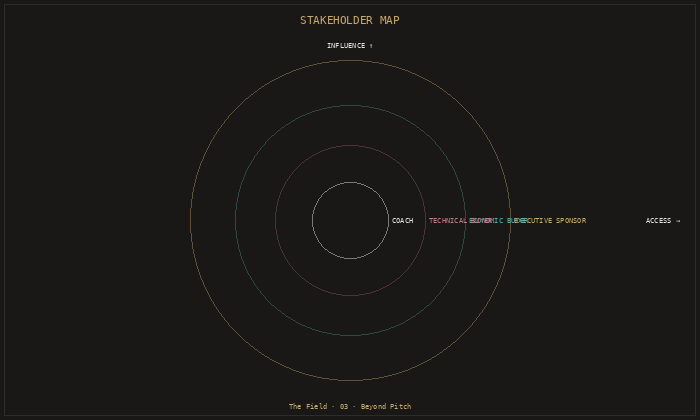
Map every person who can accelerate, influence, or block this deal. Select a quadrant to understand the engagement strategy for that type of stakeholder.
Select a quadrant to begin
Quadrants
03
Stakeholder Map
The deal you lose is rarely lost to the person you were talking to.
Select any quadrant on the map to start placing stakeholders. Work through all four quadrants to build a complete picture of who holds power, who cares, and how to engage each type.
Free to use. Export requires email.
Engagement Overview
Summarise the stakeholder landscape for this deal. Who is your strongest champion? Where is the biggest risk? What conversation are you not having yet?
On mapping the room
Most commercial failures in complex sales are not about the product. They are about people. Every significant B2B purchase involves a network of individuals with different levels of influence, different personal stakes, and different reasons to say yes or no. The Stakeholder Map makes that network visible before you need to navigate it under pressure.
The power/interest grid is deceptively simple. Power is the ability to accelerate, block, or reverse a decision. Interest is personal investment in the outcome. The four quadrants are not categories for filing people away. They are engagement strategies. A high-power, low-interest stakeholder left unmanaged becomes a silent blocker. A low-power, high-interest stakeholder nurtured well becomes an internal champion who sells on your behalf when you are not in the room.
The most useful thing this canvas produces is not the placement of people you already know. It is the gaps. The empty quadrant. The quadrant with a company name but no individual. The "Manage Closely" box with a single entry. A deal with one champion is fragile. A deal where the blockers have not been identified is dangerous. Map early, update after every significant conversation, and treat the gaps as the agenda for the next one.
In most B2B sales of significant value, the decision is not made by one person. It is shaped by a group whose members have different interests, different levels of influence, and different criteria for what a good outcome looks like. The Stakeholder Map exists to make that group visible and to force an honest assessment of where support, indifference, and active resistance are located.
The most common commercial failure in complex deals is not losing to a competitor. It is losing to internal dynamics that were never visible because the seller was only talking to one or two people. The person who manages the relationship may not be the person whose concern determines the outcome. The person who asked for the meeting may not have authority to approve the decision. The person who says nothing in every meeting may be the one who blocks it at the end.
A stakeholder map built early in a pursuit gives you a view of the decision landscape before it becomes a problem. Built late, it becomes a diagnostic for why a deal that seemed to be progressing has stopped moving. In both cases, the discipline is the same: identify everyone, assess their position honestly, and decide where to spend commercial attention.
How to use it
Start by listing every person who has a role in this decision, whether you have met them or not. Include people whose names you do not yet know by their function: the CFO, the legal reviewer, the clinical department head. An unknown stakeholder who is identified early is a gap you can close. An unknown stakeholder discovered late is a risk you were carrying without knowing.
Place each stakeholder in the map according to two dimensions: their level of influence on the decision, and their current disposition toward your solution. Influence is structural: a board member or budget holder has high structural influence regardless of how engaged they appear. Disposition reflects what you know or believe about their current attitude.
Then define an engagement strategy for each quadrant. High influence and positive: protect this relationship and keep them informed. High influence and neutral or unknown: prioritize. They can determine the outcome and you do not yet know where they stand. Low influence and positive: they may be useful advocates. Low influence and resistant: monitor, but do not over-invest.
Finally, identify your champion. A champion is not a supporter. A champion is a person with genuine interest in the outcome and the internal access to actively advocate for you when you are not in the room.
A worked example
A Nordic pharmaceutical distributor was pursuing a preferred supplier agreement with a large regional hospital group. The account manager had a strong relationship with the hospital's head of pharmacy, who had been supportive throughout the process and had requested the proposal.
When the commercial team mapped the full stakeholder landscape, a different picture emerged. The decision required sign-off from the hospital's procurement committee, which included the CFO, the Chief Medical Officer, the head of clinical risk, and two departmental directors with no prior contact with the distributor. The head of pharmacy, their primary contact, had influence over the clinical recommendation but limited authority over the procurement committee's final decision.
Mapping each stakeholder by influence and disposition revealed three gaps. The CFO was high influence and unknown: no one on the commercial team had met or profiled them. The head of clinical risk was high influence and potentially resistant: a previous supplier had introduced a logistics change without adequate clinical impact assessment, and the role had been created partly in response to that incident. The departmental directors were medium influence and entirely unmapped.
The account team restructured their approach. They requested a working session that included the CFO and used it to present total cost data that addressed budget visibility, the CFO's primary concern. They proactively developed a transition risk document for the clinical risk function before being asked, which removed the primary objection before it surfaced in committee. They identified one of the departmental directors as a potential internal advocate and involved her in the clinical reference visit they organized.
The preferred supplier agreement was awarded. The head of pharmacy's support had been necessary but not sufficient. The stakeholder map showed them where the decision was actually being made.
Common mistakes
The first mistake is mapping only the people you know. A stakeholder map populated with names gathered from two or three conversations is not a map of the decision. It is a map of your current network in the account. Actively seek to identify people whose names you do not yet have.
The second mistake is assigning disposition based on relationship warmth rather than observable evidence. A stakeholder who is polite and responsive in meetings may be personally positive while organizationally neutral. Relationship quality and commercial disposition are not the same thing. Assess disposition based on what people have said about the problem, not on how they treat you in the room.
The third mistake is building the map once at the start of the pursuit and not updating it. Stakeholder landscapes shift. Budget holders change. Organizational priorities evolve. A champion leaves. A new skeptic is appointed. The map is a living document, not a deliverable.
Frequently asked questions
How do you research stakeholders you have not met?
LinkedIn profiles, company announcements, annual reports, and industry conference speaker lists provide useful context. Your champion or internal sponsor is often the best source: a well-positioned internal advocate knows who has influence, who has concerns, and who is likely to be involved in the final decision. Ask directly and specifically.
What is the difference between a champion and a sponsor?
A champion actively advocates for you in internal conversations where you are not present. They have a personal interest in the outcome and are willing to use their political capital to support it. A sponsor may support the direction without being actively engaged in the internal process. Champions are rarer and more valuable. Identifying whether a supportive stakeholder is a champion or a passive supporter determines how much internal work you still need to do yourself.
What do you do when the map reveals you have no access to a high-influence stakeholder?
This is a commercial risk that needs to be actively managed. Options include requesting an executive briefing or working session that would naturally include that stakeholder, asking your champion to make an introduction, or identifying a route through a third stakeholder who has a relationship with them. A high-influence stakeholder you have never met, who holds an unknown or negative disposition, is the most dangerous gap in any complex deal.
Export canvas
Get your completed canvas
We will send you a confirmation email. Once confirmed, your PDF is ready to generate.
Preview — your canvas, delivered as a formatted PDF
Please enter a valid email address and accept the terms.
Check your inbox
Confirmation email sent
We sent a confirmation link to . Click the link in the email to unlock your PDF.
Link is valid for 24 hours. Check your spam folder if you don't see it.
Email confirmed
Your PDF is ready
Your email address has been confirmed. Click below to generate your report.
 Preview — your canvas, delivered as a formatted PDF