Nine sections. One structured argument for change. Build the case your buyer's finance team will actually approve.
Select a section to begin building your business case
Sections
05
Business Case Canvas
A business case not built by the seller will be built by the buyer. And rarely in your favour.
Nine sections across three phases. Start with the Problem. Finish with Metrics. The canvas becomes the foundation for the internal conversation your buyer needs to have without you in the room.
Free to use. Export requires email.
Executive Summary
Name the initiative and summarise the case in two or three sentences. What is the core argument for action, and what is the cost of not acting?
On building the case for change
Most commercial conversations fail not at the point of value, but at the point of approval. A buyer who believes in the solution still has to convince a CFO, a procurement committee, or a board that has competing priorities and a natural bias toward inaction. The seller who does not help build that internal case is not a trusted partner. They are a vendor waiting for a decision they have left entirely to chance.
The Business Case Canvas forces structure onto what is often an informal, incomplete, and dangerously optimistic internal document. Problems are underspecified. Benefits are inflated. Risks are omitted. Costs are understated. The canvas treats each of these not as sections to complete but as disciplines to apply. A weak Problem definition does not just make one section look thin, it undermines every section that follows from it.
The most effective sellers treat the business case as a co-creation exercise with the buyer, not a document they produce and hand over. When the buyer has contributed to the Stakeholders section, they own the mapping. When they have helped quantify the Benefits, they have already made the internal argument once. The canvas is not just a tool for justification. Used correctly, it is the engine of commitment.
The business case is the document the buyer uses to justify the decision internally. It is not a proposal. It is not a sales pitch. It is an internal communication tool, authored by the seller but written for an audience the seller will never meet: the finance team, the budget committee, the executive who did not attend the original meetings and has never experienced the problem being solved.
Most proposals fail not because the commercial logic is wrong but because the commercial logic is written for the person who already understands it. The champion in the room has been convinced. The document they carry back into the organization was built for a different audience with a different starting point and a different set of questions. A business case that cannot answer those questions on its own will not survive the internal review.
The Business Case Canvas structures the argument from the perspective of the internal decision-maker who needs to approve the expenditure. It forces the seller to build the argument that an otherwise uninvolved executive would find credible, not the argument that feels most comfortable to articulate from the seller's position.
How to use it
Start with the Problem Statement. Define the problem in terms that are visible and measurable to someone who has not been in the commercial conversations. Avoid product language. The problem should be described in the customer's operational or financial language, with enough specificity that an executive who was not involved in the process would recognize it as real.
Define the Baseline. What is the current state? What is the cost, risk, or opportunity being left unaddressed? This is the status quo cost, and it anchors everything that follows. Without a clear baseline, there is no meaningful way to quantify the value of the proposed solution.
Quantify the Impact. What does the proposed solution change, in measurable terms? This section must be specific enough to survive a finance team's scrutiny. Percentage improvements without base figures are not sufficient. Named, attributable savings or revenue impact estimates, even with explicit assumptions stated, are more credible than vague claims.
Address Risk. What are the risks of the proposed solution? What happens if it does not deliver? What is the risk of the current approach continuing? A business case that ignores risk is less credible than one that names the risks and addresses them directly.
Define the Decision. What is being approved? What is the timeline? What are the next steps? A business case without a clear ask is a document without a purpose.
A worked example
A Nordic B2B media and events company was pursuing a major sponsorship package from a professional services firm that provided HR and talent advisory services. The package value was 1.4 million NOK across three events and a content partnership. The commercial director at the media company had a strong relationship with the client's marketing director, who was enthusiastic about the package. But the marketing director's budget authority did not extend to this level. The decision needed CFO sign-off.
The initial proposal had been structured as a product description: event dates, audience demographics, content formats, production specifications. The CFO had returned it with one question: what is the expected commercial return?
Working through the Business Case Canvas, the team rebuilt the document. Problem Statement: the firm's primary growth channel was referral-based, which was delivering 80% of new clients at a declining rate as the market became more competitive. Without a structured pipeline of new relationships in the HR and talent leadership community, revenue growth would depend entirely on expanding the existing client base.
Baseline: in the previous 12 months, the firm had invested 600,000 NOK in two smaller sponsorship activations and generated three qualified relationship introductions, none of which had converted to revenue within the year. Cost per introduction: 200,000 NOK. Conversion rate from introduction to engagement: 0%.
Impact: the proposed package would put the firm in front of 1,200 senior HR and talent leaders across three events, with two speaking opportunities that would create direct visibility for the firm's partners. Based on the firm's average engagement value of 800,000 NOK and a conservative 2% conversion rate from relationships developed at events, the expected pipeline value over 18 months was 19.2 million NOK from a 1.4 million NOK investment.
The assumptions were stated explicitly. The risk section acknowledged that conversion rates from event relationships varied significantly and that a 0% conversion outcome was possible if the speaking content did not generate sufficient interest. The business case was approved within one week of the revised document being submitted. The CFO's original question had been answered in the language the CFO needed.
Common mistakes
The first mistake is writing the business case as a product description rather than a financial argument. Audience demographics, platform features, and production quality are not a business case. They are evidence that may support elements of the argument, but they do not constitute the argument itself. The business case answers one question: why is this investment justified?
The second mistake is leaving the quantification to the buyer. Some sellers provide qualitative value statements and assume the buyer's finance team will translate them into numbers. In most organizations, this does not happen. If the seller does not quantify the impact, it will not be quantified. And an unquantified impact is not an impact that gets approved.
The third mistake is not addressing the alternative. Every business case is implicitly competing with the option of doing nothing, doing it differently, or doing it cheaper. A business case that ignores these alternatives leaves the reviewer to construct the comparison on their own, often in ways that do not favor the proposed solution.
Frequently asked questions
Who should write the business case, the seller or the buyer?
The seller should write the first draft, using the buyer as a source of validation and correction. A business case written entirely by the buyer loses the structure and precision the seller can bring. One written entirely by the seller without buyer input will often miss the internal language, concerns, and framing that an executive in that organization would find credible. The most effective approach is a collaborative draft where the seller provides structure and financial modeling and the buyer validates and adjusts the internal framing.
How specific do the financial estimates need to be?
Specific enough to be challengeable. A business case that cannot be interrogated is not a business case that will be approved. State the assumptions, show the calculation, and be prepared to defend each number. An estimate with explicit assumptions is more credible than a claim without them, even if the estimate itself is conservative.
When in the sales process should the Business Case Canvas be introduced?
As soon as you know the decision will require approval from someone who has not been in the commercial conversations. In practice, this is almost always earlier than sellers introduce it. The canvas is most useful when built collaboratively with the champion during the proposal phase, so that the document the champion takes into the approval process has been shaped by both parties and reflects the internal language and concerns of the approving function.
Export canvas
Get your completed canvas
We will send you a confirmation email. Once confirmed, your PDF is ready to generate.
Preview — your canvas, delivered as a formatted PDF
Please enter a valid email address and accept the terms.
Check your inbox
Confirmation email sent
We sent a confirmation link to . Click the link in the email to unlock your PDF.
Link is valid for 24 hours. Check your spam folder if you don't see it.
Email confirmed
Your PDF is ready
Your email address has been confirmed. Click below to generate your report.
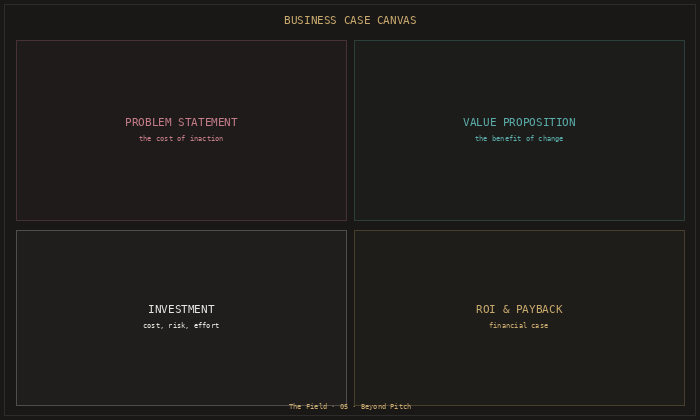 Preview — your canvas, delivered as a formatted PDF