Build a precise profile of your buyer as a person. Who they are, what drives them, and what it takes to earn their attention. Select a section to start.
Select a section to begin
Sections
02
Buyer Persona Canvas
Most commercial conversations fail because the seller understands the product better than the person.
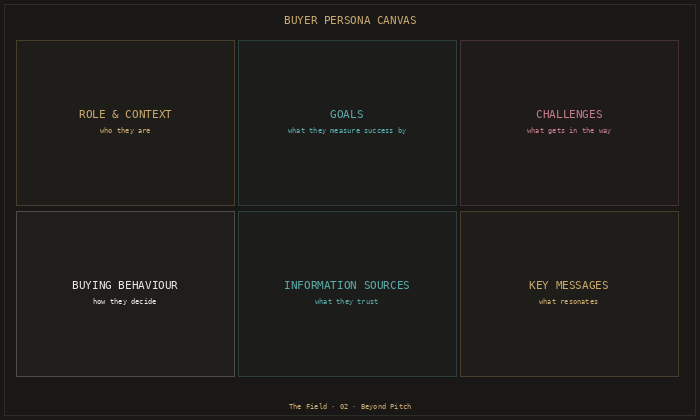
Select any section on the canvas to start building your buyer profile. Work through the six dimensions to build a complete picture of who you are selling to.
Free to use. Export requires email.
Persona Summary
Summarise this buyer in one or two sentences. Who are they, what drives them, and what does it take to earn their attention? Use this as your internal brief before a conversation.
On using this canvas
Most commercial conversations are built around the product, not the person. Sellers know their offering well. They know far less about the human across the table: what that person is measured on, what risk they personally carry, and what a successful year looks like for them. The Buyer Persona Canvas closes that gap before the conversation starts. Not during it.
A persona is not a demographic. Role, industry, and company size are the least useful parts of a profile. The sections that create real commercial leverage are the ones that reveal motivation and movement: what drives this person toward a decision, and what holds them back. A profile with strong entries in Goals, Pains, Triggers, and Objections is worth more than one that describes the buyer in detail but cannot predict how they will behave in a commercial situation.
The most important thing to understand about the Buyer Persona Canvas is that it is never finished. The most useful version is the one that is updated after every significant conversation. Each meeting either confirms what you believed about this buyer type or challenges it. That correction is the input. Over time, the canvas becomes a compounding asset: a precise picture of your buyer that makes every subsequent conversation sharper, better prepared, and more likely to create the kind of value that earns trust and earns access.
The Buyer Persona Canvas is not a demographic profile. It is a map of the person who sits across the table: what they are responsible for, what they are measured on, what keeps them from sleeping well, and what would make them look good to the people they report to. A commercial team that has done this work properly enters every conversation knowing what the person in that role is likely to care about before the first question is asked.
The distinction between a persona and a job title matters. Two people with the same title in different organizations can have radically different priorities, pressures, and decision-making authority. The canvas is useful precisely because it forces specificity: not "CFO" as a category but this kind of CFO in this kind of organization at this stage of the company's commercial development.
Personas built from assumption are not personas. They are projections. The canvas becomes genuinely useful when it is built from direct observation: what actual buyers in this role have said in discovery conversations, what objections they have raised, what language they have used to describe their situation. Until that input is present, the canvas is a hypothesis to be tested, not a profile to be applied.
How to use it
Begin with the role and context. Define not just the job title but the type of organization and the commercial situation in which this buyer is operating. A procurement director at a 200-person manufacturer has a different profile than a procurement director at a 2,000-person publicly listed industrial group, even though they carry the same title.
Work through Goals and Metrics. What does success look like for this person over the next 12 months? What are they formally measured on? These are often different from each other. A commercial director might be formally measured on revenue while their primary concern is margin quality and the sustainability of the pipeline. Understanding both gives you two entry points into what they care about.
Then map Pains and Challenges. What is making their job harder than it should be? What risks are they carrying? What conversations do they dread? What did the last supplier get wrong? These answers are the foundation of pain-based commercial positioning.
Finally, identify Decision Criteria and Objections. How does this person evaluate a supplier? What would cause them to say no at each stage of the process? What does a credible vendor look like to them?
A worked example
A Scandinavian manufacturer of heavy lifting equipment was expanding sales into the Norwegian offshore and construction sectors. The commercial team had been pitching to procurement managers and losing on price. When they built a proper persona for their actual economic buyer, the operations director at large construction contractors, the picture shifted.
Goals and metrics for this persona: project delivery on schedule, zero critical equipment failures during active project phases, and reducing unplanned downtime across a portfolio of active sites. They were measured on project margin, not equipment unit cost.
Pains: unreliable availability of replacement parts for equipment already in the field, inconsistent service response times across regions, and equipment suppliers who disappeared after the purchase order was signed. The persona's primary risk was not buying expensive equipment. It was buying equipment that would fail on-site at a cost they could not predict or control.
Decision criteria: demonstrated uptime track record, service network density in their operating regions, and reference customers in comparable project environments. Price was a constraint, not the primary criterion.
Armed with this persona, the commercial team stopped leading with specifications and started leading with uptime data, service response commitments, and case studies from similar project environments. Win rate against the low-price competitor increased materially within two quarters, not because price changed but because the commercial conversation changed.
Common mistakes
The first mistake is confusing the gatekeeper persona with the economic buyer persona. In most B2B situations, the person who manages the procurement process and the person who ultimately approves the decision are different. Building a detailed persona for procurement while having only a vague profile of the economic buyer leaves the most important conversation underinformed.
The second mistake is building the persona once and treating it as permanent. Personas evolve. A CFO who joined from a cost-reduction background develops different priorities after three years in a growth-focused organization. Return to the canvas each time a significant account is at stake and ask whether the profile still matches what recent conversations have revealed.
The third mistake is building the same persona for every account in a segment. Within any segment, there are subsets of buyers with meaningfully different profiles. An operations director at a contractor who has had one major equipment failure has a different pain hierarchy than one who has never experienced it. Segment-level personas are starting points. Account-level personas are commercial tools.
Frequently asked questions
How many personas should we build for a single deal?
In complex B2B deals, most purchase decisions involve three to six people with meaningfully different profiles. At minimum, build a persona for the economic buyer and one for any champion or coach who will advocate for you internally. If a specific technical evaluator or procurement lead is likely to block the deal, build a persona for them as well.
What is the best source of data for building an accurate persona?
Direct discovery conversations are the primary source. Secondary sources include review sites, industry association publications, LinkedIn profiles of people in the role, and post-deal debrief notes from previous wins and losses. Assumptions and internal opinion are the least reliable source and the most commonly used.
How is the Buyer Persona Canvas different from the customer profile in the Value Proposition Canvas?
The customer profile in the VPC focuses on functional jobs, gains, and pains as they relate to a product or service category. The Buyer Persona Canvas focuses on the full professional and decision-making context of a specific person: their goals, metrics, pressures, and how they evaluate and select suppliers. Both tools are useful. The persona informs how to engage with a specific individual. The VPC informs what to position and why.
Export canvas
Get your completed canvas
We will send you a confirmation email. Once confirmed, your PDF is ready to generate.
Preview — your canvas, delivered as a formatted PDF
Please enter a valid email address and accept the terms.
Check your inbox
Confirmation email sent
We sent a confirmation link to . Click the link in the email to unlock your PDF.
Link is valid for 24 hours. Check your spam folder if you don't see it.
Email confirmed
Your PDF is ready
Your email address has been confirmed. Click below to generate your report.
 Preview — your canvas, delivered as a formatted PDF