A price objection is a signal that the value case has not been made with enough clarity for the customer to feel confident paying the difference. The number is visible. The value is not. When one is visible and the other is not, the visible one wins. This is not a pricing problem. It is a commercial preparation problem.
A price objection is a signal. The question most sellers get wrong is what it is a signal of.
The instinct is to treat it as feedback about the number itself: the price is too high, the competitor is cheaper, the budget is constrained. And so the response is directed at the number, justifying it, defending it, discounting it, or reframing it into monthly instalments. None of these responses addresses what the objection is actually telling you.
In most cases, a price objection in a late-stage commercial conversation is not a statement about price. It is a statement about value, specifically that the value case has not been made with enough clarity and conviction for the customer to feel confident paying the difference. The number is visible. The value is not. And when one is visible and the other is not, the visible one wins.
This is not primarily a problem of pricing strategy. It is a problem of commercial preparation, and the distinction matters significantly for how you choose to respond.
01The trap most sellers walk into
When a customer says "I have a competing offer at X percent lower," there are several ways to respond, and most of them make the situation worse.
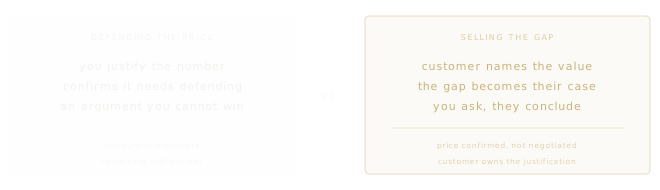
Defending the price converts the conversation into an argument the seller cannot win. The customer has already heard your price and decided it needs justification. Offering that justification confirms their framing: that the price requires explanation, which means it is hard to justify on its own terms.
Discounting creates a different problem. It works in the short term and costs in the long term. It signals that the original price was not real. It sets a precedent for every future negotiation with this customer. And it does nothing to address the underlying dynamic: the customer still does not understand what they are paying for, and the seller has now taught them that patience is a procurement strategy.
Breaking the price into components, offering extended payment terms, or presenting alternative pricing structures all share the same flaw. They redirect the conversation toward financial mechanics at the moment when the real conversation should be about value. They are solutions to a problem the seller invented.
The fundamental error in all of these responses is the same: they accept the premise that price is the issue. It almost never is.
There is also a second assumption embedded in how most sellers approach this moment: that the objection signals the customer is leaning toward a competitor. In many cases, the opposite is true. A buyer who had genuinely decided against a supplier does not negotiate on price, they simply decline. A buyer who raises price as the remaining obstacle is often signalling that they want to find a way to make it work. The objection is not a rejection. It is an invitation to finish a value conversation that was started but not completed.
02What a price objection actually reveals
When a customer raises price as a late-stage concern, it tells you something specific about the state of the commercial relationship. It tells you that the customer has not yet fully connected what they would be paying with what they would be getting. The value case is either missing, unclear, or not sufficiently owned by the customer.
This distinction matters. There is a difference between a value case that exists in the seller's mind and a value case that the customer has genuinely internalised. Sellers spend considerable energy building the former and relatively little ensuring the latter. The result is that the customer arrives at the final negotiation with a price in one hand and an incomplete picture of what justifies it in the other.
The price objection is the gap between those two things making itself visible.
Research on anchoring in decision-making is instructive here. When the first number a buyer encounters is the competitor's price, that number becomes the reference point against which everything else is evaluated. The seller's higher price is experienced as a deviation from a norm, not as a premium that reflects additional value. Closing that gap requires either moving the anchor or making the value of the deviation viscerally clear. Most sellers try to move the anchor. The more effective approach is to address the value.
The good news, if it can be called that, is that the customer who raises price as the final obstacle has usually already made a tentative decision in your favour. If they had not, the conversation would be over. The price objection is their way of asking you to give them a reason to justify what they have already decided they want to do. That is a more tractable problem than it appears.
03Sell the Gap
The model that addresses this dynamic has a straightforward structure, though it requires discipline to execute well. Its core logic is simple: rather than defending the price yourself, ask the customer to articulate the value of the difference. You are not selling price against price. You are asking the customer to sell the gap themselves.
A customer who has named the reasons they prefer you is in a very poor position to simultaneously argue that those reasons are worth nothing.
Ask directly, without pressure: "If I were to match the price you have been offered, would you choose us?" This surfaces whether you are the preferred supplier and establishes the logical foundation for what follows. A customer who answers yes has confirmed that price is the only remaining variable, and that in a world where price is equal, they would choose you. That is a significant admission.
Follow immediately: "If that is the case, what is it about working with us that makes us the right choice for you?" When the customer answers, they describe your differentiation in their own words, against their own priorities. Track record. Delivery capability. Strategic alignment. Support quality. Risk reduction. These are not claims the seller made. They are facts the customer stated.
Ask the customer to value what they just described: "Based on what you have told me, how do you think about what the gap in price represents for your organisation?" This is not a challenge. It is an invitation. The gap between the two prices is no longer a concession being asked of the seller. It is the cost of the difference the customer articulated themselves.
You are not selling price against price. You are asking the customer to sell the gap themselves.
The closing question can be phrased several ways depending on the relationship and the moment. The principle is constant: the customer should be the one to draw the conclusion, not the seller. "You have yourself pointed to what sets us apart. What do you think is the right amount to pay for that difference?" is more effective than any version of "our premium is justified because." One is persuasion. The other is evidence.
The tone throughout should be calm and genuinely curious, not confrontational. You are not trapping the customer. You are inviting them to be honest with themselves about what they have already told you they value. That is a conversation they are usually willing to have, because it gives them something to take back internally: a reason, in their own words, to justify the decision they have already tentatively made.
When the model does not work
This approach has a failure mode worth being direct about, because pretending otherwise would make the model less useful.
If a customer responds to the closing question by saying the gap is not worth anything, there are three possible explanations. The first is that the response is tactical. The customer is in a negotiation and is playing a hand. In this case the right move is to reflect the inconsistency calmly: "That is interesting, because you just described those factors as the reason you prefer us. Help me understand what you mean when you say they do not have value." This is not confrontational. It is an invitation to be more precise, and it is very difficult to answer without revealing that the original position was a posture.
The second explanation is structural. In large complex purchases, the person negotiating price is often not the person who will use the product or carry the operational risk. They may genuinely believe the differentiating factors are irrelevant, because for their role they are. In this case the right question is about who else should be involved in the conversation: "Are the people who will be working with this solution day to day part of this decision? I ask because the factors you mentioned tend to matter most to them." This is not an attempt to go around the negotiator. It is a recognition that the decision has dimensions that are not being represented in the room.
The third explanation is the one that requires the most honesty: the customer is right. If a customer genuinely does not experience your differentiation as valuable enough to justify the price difference, the problem is not in the negotiation. It is earlier in the process. The value case was not built with enough rigour in the discovery phase. The differentiating elements were described but not connected to the customer's actual situation and priorities. In that case, no closing technique repairs the gap. The only honest response is to step back and understand what actually matters to this customer before asking them to pay for something they do not yet value.
When the third scenario applies, Sell the Gap is not a negotiation that failed. It is a diagnostic that revealed something useful: that the deal, as currently structured, is not ready to close, and that pursuing it by reducing price simply delays the reckoning rather than resolving it.
05The price conversation starts before the price conversation
The instinct in most commercial training is to treat price objections as a late-stage problem requiring a late-stage solution. The frame here is different.
If you find yourself regularly in the position of defending a price difference against a competitor, it is worth asking what that pattern is telling you. It is usually not that your prices are wrong. It is that the value case is being built too late, too abstractly, or with too much focus on what you offer rather than what the customer loses by going a different direction.
The economics of value in B2B selling are straightforward in principle: a customer will pay a premium when they understand clearly what they are getting in exchange for it and when that understanding is theirs, not borrowed from the seller's presentation. The gap between price and willingness to pay is almost always a gap in understanding, not a gap in budget.
The customer who arrives at the final negotiation already convinced of your differentiation does not need to be persuaded on price. They need help finding a way to justify internally what they have already decided. That is a very different conversation, and a considerably easier one. The seller who has done the earlier work well often finds that the price conversation resolves itself, not because it never happens, but because the customer already knows the answer by the time it does.
I have had this conversation from both sides of the table. The version where the value case was built well and the customer is mostly looking for confirmation is qualitatively different from the version where the seller is trying to convince a buyer who has never been helped to see why the difference matters. The first feels like a natural conclusion. The second feels like an argument. And arguments, in commercial settings, produce concessions rather than conviction, which is a poor foundation for what happens after the contract is signed.
Price is a number. What justifies it is a story the customer has to believe, told in their own words, grounded in their own situation. The seller's job is to ask the questions that help them tell it. Sell the Gap is not a technique for the end of a sales process. It is a consequence of having done the earlier work well enough that the customer already knows what the difference is worth. They just need someone to ask.
Frequently asked questions
What does it mean to sell the gap in B2B negotiations?
Selling the gap means shifting the negotiation away from defending your price and toward helping the customer articulate the value of the difference themselves. Rather than justifying the price premium, you ask the customer to describe what makes you the preferred choice, then invite them to put a value on those factors. The customer ends up selling the gap, not you, which is significantly more persuasive because the reasoning comes from their own assessment of their situation.
How do you respond to a price objection without discounting?
Start by establishing whether you are the preferred supplier: ask directly whether the customer would choose you if price were equal. If yes, ask what makes you the preferred choice. That question surfaces the customer's own articulation of your differentiated value. Then ask them to consider what the gap in price represents given what they just described. You are not defending the price. You are asking the customer to assess whether the value they named is worth the difference they are being asked to pay.
When does a price objection mean the deal is lost?
When the customer genuinely does not experience your differentiation as valuable enough to justify the price difference. If that is the case, the problem is not in the negotiation, it is earlier in the process. The value case was not built with enough rigour in the discovery phase. No closing technique repairs that gap. The most honest response is to step back, understand what actually matters to this customer, and determine whether this is a deal worth pursuing on different terms or not at all.