CRM (Customer Relationship Management) is a category of software used by commercial organisations to track customer interactions and manage pipeline. Its highest commercial value lies in using it as a map of the customer's buying process, not as a record of the seller's activity.
CRM has become the most universally deployed and most consistently underused tool in B2B commercial organisations. The investment is substantial. The adoption, in most teams, is not. And the gap between the two is rarely caused by the technology.
Most organisations that struggle with CRM adoption have the same diagnosis: sellers resist the system, data is incomplete, and leadership sees a pipeline they cannot trust. The common response is more training, stricter enforcement, or a platform migration. Research on CRM adoption consistently finds that these responses rarely work, because they treat a positioning problem as an execution problem. None of them address the underlying issue.
The underlying problem is that CRM has been positioned as a reporting tool rather than a commercial thinking tool. In industries where digital adoption has been slow, that positioning has been reinforced for years by how the system was introduced and what it was actually used to measure.
01The contact directory
When sellers describe their CRM, the most common framing is a place to log calls and look up contact details. A glorified address book with activity tracking attached.
This framing is not a misunderstanding. It reflects exactly how most CRM systems are used. The data that gets entered is the data that has to be entered: notes from meetings, status updates that satisfy a weekly report, contact information that would take too long to find any other way.
What does not get entered is the data that would make the system genuinely useful: the customer's actual situation, their internal decision dynamics, where they are in their buying process, what they have said about their priorities, who holds real authority, and what would have to be true for them to change. That information exists. It lives in the seller's head. And when the seller moves on, it leaves with them.
The result is a CRM that holds activity but not insight. It can tell you how many calls were made. It cannot tell you whether the right conversations are happening, whether the pipeline is real, or which deals will actually close. For a sales leader trying to build a forecast or coach their team, it provides almost no useful information at all.
02Why conservative industries struggle most
In technology companies, CRM adoption tends to be higher. The culture is more digital, the workflows more structured, and the commercial model is often subscription-based, which requires systematic tracking of renewals, expansions, and churn. The system earns its place because the consequences of not using it are visible and immediate.
In manufacturing, maritime, construction, professional services, and financial services, the dynamic is different. Relationships are longer, sales cycles are longer, and the dominant commercial model has historically been relationship-led rather than process-led. A seller who has managed the same accounts for fifteen years knows their customers better than any system does, and they know it.
Maritime is a particularly clear example. Shipowners, charterers, and operators work within tight networks where reputation and personal trust carry substantial commercial weight. Deals are made at industry gatherings and over long lunches, and the same counterparts appear across multiple transactions over decades. In that environment, the idea of capturing the relationship in a software system can feel not just unnecessary but slightly beside the point.
This is not wrong. Relationship quality in these industries is genuinely important. But it creates a specific blind spot. The seller who relies entirely on personal knowledge is not scalable, not coachable, and not replaceable without significant disruption to the accounts they own. And the organisation that depends on that seller has no commercial visibility beyond what that seller chooses to share.
When CRM is introduced into these environments, it is typically positioned as a reporting requirement: log your activity, update your forecast, let us see the pipeline. That positioning confirms every concern the seller already had. The system becomes administrative overhead. Not commercial infrastructure.
The sellers who resist CRM are not being obstructive. They are making a rational choice about a system that offers them nothing in return.
Until the system offers something in return, that calculation does not change. And the typical responses, more enforcement, better training, a new interface, do not change what the system is actually for.
03Data quality is a consequence, not a cause
There is a version of this problem that sounds like a technology problem but is actually a philosophy problem. Poor CRM data is not primarily caused by bad systems. It is caused by sellers who see no value in entering information they already know, into a system they do not trust, for managers who use it to check whether targets are being met.
That dynamic only changes when the data in the system serves the person entering it.
When a seller can open their CRM and see a genuine map of their pipeline: not just a list of accounts and activity, but a real picture of where each opportunity sits in the customer's decision process, what is known and unknown, what the next meaningful action is. When that is what the system shows, the reason to maintain it changes. The system stops being a report and becomes a tool.
Data quality follows from this shift, not the other way around. When the system earns its place in the seller's daily workflow, the data improves as a consequence. When it does not, no enforcement mechanism produces sustained data quality. You get compliance for a month, then drift. Then another initiative. Then the same result.
The organisations that break this cycle do not do it by making CRM mandatory. They do it by making CRM useful. And making CRM useful requires a decision about what it is actually supposed to show.
04CRM as a decision journey map
The insight that changes how CRM is built and used is this: the customer is not in a sales process. The customer is in a buying process. And that buying process moves through stages that have their own logic, their own internal drivers, and their own requirements of the seller at each point.
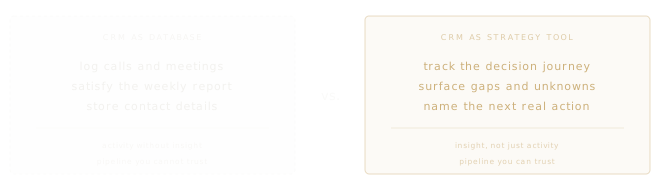
A CRM built around this reality looks fundamentally different from one built around seller activity. Instead of logging calls and meetings, it tracks where the customer is in their own decision journey. Instead of measuring activity volume, it surfaces what the seller knows about the customer's situation and what they still need to find out. Instead of generating a forecast based on percentage probabilities that nobody trusts, it creates a picture of pipeline quality that reflects the actual state of the buying decision in each account.
Every opportunity should be positioned against a clear model of how this type of customer makes this type of decision. Not a generic sales stage, but a specific reflection of where the customer is in their own process: what they have decided, what remains open, and what would constitute genuine progress.
The most useful thing a CRM can surface is what the seller does not yet know. Who holds real authority in this decision? What is driving the timing? What alternative is the customer considering? The gaps in understanding are the gaps in the commercial strategy, and they are invisible if the system only captures what has happened.
In complex B2B decisions, the contact who takes your calls is rarely the person who makes the final decision. A CRM that reflects only the seller's primary contact does not reflect the decision. Mapping the full buying group, with an honest assessment of where each stakeholder stands, is the commercial intelligence that actually matters.
Every opportunity in the pipeline should have a specific, time-bound next action that would move the customer's decision forward. Not a follow-up call. A specific conversation that changes what the customer understands or decides. If that action cannot be named, the deal is not being managed. It is being monitored.
This requires more than a software configuration. It requires that the commercial team has a shared understanding of how their customers' buying decisions actually work: what triggers them, how they progress, where they typically stall, and what moves them forward. That understanding is commercial methodology. Without it, CRM is just a database. With it, CRM becomes a tool for applying that methodology consistently, at scale, across the entire commercial team.
05What it looks like when it works
An experienced seller who uses CRM well does not spend more time in the system. They spend less, because the information they need is available when they need it. They begin each week with a clear picture of their pipeline: which opportunities are progressing, which are stalling, and what is required in each. They can prepare for a customer conversation because the relevant context is already captured. They do not have to reconstruct the situation from memory or email history every time.
A sales leader who manages through a well-structured CRM does not need to spend the first twenty minutes of every team meeting asking sellers for pipeline updates. The pipeline is visible. The quality of the pipeline is visible. What the meeting can address instead is what actually matters: the strategy behind the key opportunities, the coaching the seller needs, the decisions that are still pending.
I have worked with commercial teams in traditional industries where this shift has been visible and measurable. The change, when it happens, is not in the technology. It is in the decision to build the system around how the customer decides rather than around what the organisation needs to report. That decision changes what gets entered, what the system can surface, and what the team uses it for.
The sellers who embrace it first are typically the most experienced. Because they understand, more clearly than anyone, the difference between activity and progress. And they recognise, once the system is structured correctly, that it gives them something they have been missing: a reliable picture of their own pipeline that they can trust and act on.
06Technology without methodology is noise
The broader point behind all of this is one that applies across every technology investment a commercial organisation makes.
Technology amplifies what is already present. A seller with a genuine commercial approach and the right tools to support it can achieve substantially more than one with either element alone. A seller who lacks that approach will use a sophisticated system to do the wrong things faster, and produce better-looking reports about why the pipeline is not converting.
CRM is the most visible example of this dynamic in commercial organisations, because it is the most widely deployed technology and the one where the gap between investment and return is most consistently visible. Research consistently identifies adoption and change management, not technology selection, as the primary determinant of whether a CRM investment delivers commercial value. But the principle extends to every tool in the modern commercial stack. AI-assisted preparation, digital value communication, pipeline analytics. None of these deliver their potential without a commercial philosophy that defines what good actually looks like.
That philosophy is the methodology that makes technology useful. Without it, the most capable tools available produce more noise at greater speed. With it, technology becomes what it was always supposed to be: a multiplier on the craft of people who already know what they are doing.
The organisations that get this right are not the ones with the most advanced technology. They are the ones with a clear commercial approach and the discipline to apply it consistently, supported by systems built around that approach rather than adopted as a substitute for it.
CRM done right is not a data entry exercise or a management surveillance tool. It is a shared commercial language, expressed in a system that keeps the whole team oriented around the same thing: where the customer is, what they need, and what the seller should do next.
That is worth building. And it is worth the investment required to build it correctly the first time.