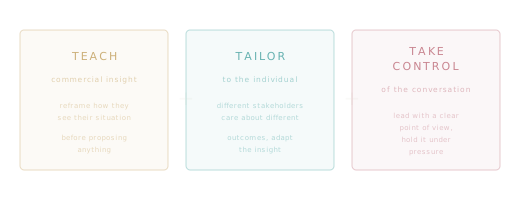
The Challenger Sale is a commercial methodology developed by Matthew Dixon and Brent Adamson at the Corporate Executive Board, identifying teaching, tailoring, and taking control as the three behaviours that most consistently separate high performers from average ones in complex B2B sales environments.
The Challenger Sale has been on more sales leadership bookshelves than almost any other title of the last two decades. It is regularly cited in strategy discussions, referenced in training programmes, and used as shorthand for a certain kind of commercial ambition.
It is also, in most organisations, fundamentally misunderstood.
Not the label. Most leaders know the label. What tends to get lost is the substance: what Challenger behaviour actually requires, and why it is genuinely difficult to develop at scale.
I have encountered this misunderstanding often enough to believe it is almost inevitable. The name sets up an expectation of confrontation. And in commercial environments where sellers are under pressure to demonstrate activity and assertiveness, "challenging the customer" can become a justification for behaviour that the original research explicitly did not endorse. The result is a model that organisations believe they have adopted while continuing to practise something quite different.
01Why the name misleads
The word "Challenger" creates its own problem. It implies aggression. Pushback. A seller who is willing to tell the customer they are wrong. Many organisations have taken that reading and built training programmes around confrontation, assertiveness, and the willingness to push back on price objections.
That is not what the research found.
What distinguishes high-performing sellers in complex B2B environments is not that they argue. It is that they arrive prepared. They have thought about the customer's world. They have formed a view. And because they have done that work, they can say something in the room that the customer had not expected to hear from a commercial conversation.
The tension that sometimes follows is a byproduct of having a genuine perspective. It is not a technique to deploy.
I have seen this misapplication across industries. In one case, a commercial team had been trained to "challenge" objections and "hold their position" on pricing. The framing was Challenger. The actual behaviour was adversarial. Customers felt argued with rather than understood, and the win rate declined. The problem was not the methodology. It was a surface-level reading of it that missed the point almost entirely.
02Three things, always together
Teaching, tailoring, and taking control are not independent techniques. They are a sequence, and the sequence is the methodology.
The Challenger approach has three components. Practice applying them with the Challenger practice exercise. In practice, the third is often adopted without the first two. That is where the misapplication begins.
The three components are not independent techniques you can selectively deploy. They are a sequence, and the sequence matters. You cannot tailor for a specific stakeholder if you have not developed a genuine industry insight to start from. You cannot take control of a conversation if you have not established a perspective worth holding. Each element builds on the one before it, and stripping any of them out changes the nature of what remains.
Give the customer a new way of seeing their own situation. Not a product pitch. A perspective on their market or position that reframes what matters. The test: does the customer leave the conversation having understood something they did not fully understand before they walked in?
Translate that perspective for the specific person in the room. The insight that moves a CFO is not the same insight that moves a Head of Operations. What changes is the language, the stakes, the angle. Tailoring is not about telling people what they want to hear. It is about making a genuine insight land for the person who needs to act on it.
Lead the commercial conversation with confidence. Not by being domineering, but by having a clear point of view and the discipline to hold it when the customer pushes back, redirects, or defaults to negotiating on price. Control is what happens when you are more prepared than the situation requires.
Most organisations focus on Take Control and neglect the two that precede it. The result is sellers who push harder without giving the customer anything to push toward. That is not Challenger behaviour. It is persistence with a new name.
Understanding these three as a system, rather than a menu, is the starting point for building Challenger capability that holds up in practice. The model is not complicated. But it requires genuine investment in the first two components before the third becomes available. That investment is where most organisations fall short.
03The relationship seller is not the enemy
The data does not say relationships are unimportant. It says that in complex B2B environments, relational skill alone is insufficient when customers face real decisions and real risk.
The original research positioned the Relationship Builder as the lowest-performing profile in complex sales environments. That finding has been used, incorrectly, to justify dismantling relational capability in commercial teams.
Relationships are not the problem. Relationships that carry the entire commercial conversation are the problem.
What the data actually shows is that relational skill alone is insufficient where customers face complex decisions, multiple stakeholders, and real risk. It does not show that relationships are unimportant. It shows that relationships need to be accompanied by something else.
A seller who can both maintain trust and introduce genuine challenge is operating at a different level entirely.
I have worked with commercial teams where relational selling was deeply embedded in the culture, often because it had worked well for a long time and in some cases because the founders had built the business on exactly that foundation. In those environments, introducing Challenger thinking requires care. The goal is not to dismiss what has worked. It is to add what is needed for the situations where relational capability alone is no longer sufficient.
The relational seller who also develops genuine Challenger capability is not replacing one skill with another. They are expanding their range. They can still use trust and history when those are the right tools. And they gain access to a completely different kind of conversation in the situations where trust alone cannot carry the weight.
The first article in this series described value-based selling as a muscle that most commercially capable people have never needed to develop. The Challenger approach is the same thing, seen from inside the conversation. It is not a replacement for what good sellers already know. It is the layer that makes what they know count in more situations, with more customers, across a longer career.
04Before the room
The practical implication of Challenger behaviour is almost entirely about preparation.
You cannot teach a customer something new about their situation without genuinely understanding their situation. That requires knowing the customer's industry well enough to have formed a view on where it is heading. It requires understanding what specific pressures apply to the organisation in front of you. And it requires having thought through how what you offer connects to those pressures in a way that is specific to this person, in this role, at this moment.
That is not a conversation you can improvise. It is not something product knowledge covers. It is a distinct preparation discipline that most commercial organisations never build into their processes, because they have not understood that preparation is the actual differentiator, not delivery.
The parallel I come back to most often is from idretten. Elite athletes do not arrive at competition hoping to improvise their way to performance. They have trained specific movements, practised responses to specific scenarios, and built the kind of automaticity that lets them be fully present in the moment rather than thinking through technique under pressure. Preparation is not a constraint on performance. It is what makes performance possible in the first place.
Commercial preparation works the same way. The seller who walks into a significant conversation with a well-formed perspective on the customer's industry, a clear view of the pressures most relevant to the person in the room, and a hypothesis about what their situation actually requires is not executing a technique. They are having a different quality of conversation. And that quality is available to almost anyone, provided they have done the work that makes it possible.
The sellers who appear to be naturally challenging are, in almost every case, simply better prepared.
05A standard, not a personality
One of the most useful reframes I have found in working with commercial teams is this: Challenger is not a type of person. It is a level of preparation.
You do not become a Challenger seller because you are naturally confident, or naturally comfortable with tension. You become one because you have done the work before the room. You have a perspective. You have considered how it applies to this specific customer. You are prepared enough to hold it under pressure.
That is achievable for most sellers. It is just rarely demanded of them.
The organisations that do demand it tend to discover something important: the sellers who resist it most at the start are often the ones who benefit from it most. Because preparation discipline gives them something they did not previously have access to, a way to be confident in rooms where experience and relationship alone cannot carry the conversation. That kind of confidence is not personality. It is competence. And competence, unlike personality, can be built.
The organisations that get it right treat preparation as a capability, not an afterthought. They build insight development into their commercial processes. They expect their sellers to arrive at significant conversations with a genuine point of view, not just a presentation. And they understand that the question is never whether their sellers can deliver. It is whether their sellers have anything worth saying before they open their mouths.
When that standard is in place, the conversation changes. And when the conversation changes, so does what the customer is willing to pay for.
Frequently asked questions
What is the Challenger Sale approach?
The Challenger Sale is a commercial approach developed by Matthew Dixon and Brent Adamson, published in their 2011 book of the same name. Based on research into thousands of B2B sales professionals, it identified teaching, tailoring, and taking control of the commercial conversation as the behaviours that distinguish the highest performers.
Is the Challenger approach about being aggressive or confrontational?
No. Challenging a customer means constructively disrupting their thinking with relevant insight. It is not about conflict or pressure. Done well, it creates real value for the customer by helping them see their situation more clearly and make better decisions.
What are the three behaviors that define a Challenger?
Teach: share an insight that reframes how the customer sees their situation. Tailor: adapt the message to the specific concerns and priorities of each stakeholder. Take Control: lead the commercial process with confidence rather than deferring to the customer at every step.