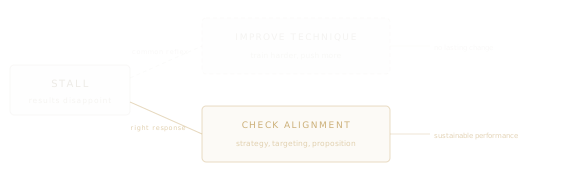
Strategy before selling is the principle that commercial performance depends first on strategic alignment: who the organisation targets, with what proposition, and why those customers should buy. Not on sales technique or execution alone.
The room was full of experienced salespeople. Not inexperienced ones. Not people who lacked confidence or product knowledge. They had been selling successfully for years, building relationships, winning trust, and closing deals in an industry where relationships genuinely matter.
And yet the pipeline was dry.
No new contracts for a sustained period. Existing relationships holding, but not growing. The organisation was working hard and producing little. When I came in, the instinct from leadership was predictable: the sellers needed to improve. More structure. More methodology. Better technique.
They were not entirely wrong. But they were asking the wrong question first.
I have sat in that room more than once. The details shift: the industry changes, the product changes, the team changes. But the pattern holds. When commercial performance stalls, the instinct is to look at what is visible. People are visible. Strategy is not. And so the response is almost always to train harder, push harder, and measure more carefully, while the questions that actually matter go unasked.
01The reflex that costs organisations years
When commercial performance stalls, the default response is to improve what is visible. Sales technique is visible. How someone runs a meeting, structures a proposal, handles an objection. These are observable, trainable, and relatively straightforward to diagnose.
What is harder to see, and far more consequential, is what happens upstream: the strategic decisions that determine who you are selling to, what you are competing on, and whether your activities are actually aligned with the customers you need to win.
Technique improvement is powerful. But it only works if the strategic foundation beneath it is sound. You can train your sellers to be more precise, more challenging, more value-oriented, and still watch the pipeline underperform because the strategic decisions that direct their effort have never been interrogated.
This is the gap most organisations never close.
I have worked with commercial teams in construction and real estate, in manufacturing, in IT services, and in retail. The capability levels differ. The dynamic is recognisable in all of them. The moment senior leaders stop asking "why are our sellers not getting better results?" and start asking "why are our sellers pointing their effort at the wrong customers?" is when real progress becomes possible. It is also, in my experience, a question most organisations arrive at much later than they should.
02A framework that tells the truth
Strategic coherence is not the alignment of words in a strategy document. It is the alignment of four elements that most organisations have never placed next to each other at the same time.
There is a model I return to repeatedly when working with commercial organisations. It maps four interconnected elements: Goals, Customers, Activities, and Resources.
What the organisation needs to achieve, commercially and strategically. Not just revenue targets, but the direction that gives those targets meaning.
Not everyone who might buy from you. The specific segments where you can win, where you can deliver disproportionate value, and where winning is worth the cost.
What you must actually do to attract and retain those customers. Can you do it better, more consistently, or differently than your competitors?
What you have to work with: capability, people, relationships, knowledge. The assets that either enable or constrain the activities you are choosing to compete on.
Most leaders, when they encounter this model, read it as a sequence. You start with goals, define your target customers, design your activities, and allocate your resources accordingly. That logic is not wrong. But it is incomplete.
The more useful insight is that this is not a linear model. It is a system. In practice, you rarely have the luxury of starting at the top. Sometimes the honest starting point is resources: what are we actually capable of delivering, right now, with what we have? Sometimes it is customers: who are we already serving, and what does that tell us about where we actually compete?
The critical discipline is not where you start. It is whether, by the time you are done, all four elements are coherent. Goals that do not connect to real customer needs are ambitions without traction. The Coherence Map framework is designed to test this alignment explicitly. Activities that do not leverage what makes you distinctive are just effort. Resources that are not directed toward the right customers are waste.
The question most organisations avoid asking is this: do our four elements actually cohere?
What I find, almost without exception, when I sit down with a commercial leadership team and work through these four elements honestly, is that the gaps between them are larger than anyone expected. Not because the people involved are not thoughtful. But because these elements are rarely placed next to each other in a way that makes the misalignments visible. The model does not create problems. It reveals them. And revealing them is the precondition for doing anything about them.
03What was really wrong
Back to that room of experienced sellers.
When I worked through the strategy model with their leadership, something became clear quickly. The organisation had built its commercial capability around a specific type of customer: long-term accounts where trust was already established, where the sales cycle was based on relationship maintenance rather than value creation.
This pattern is particularly visible in industries where the market was stable for a long period. In the manufacturing and construction environments I have worked in, the relationships that built a business over two decades are real, valuable, and not easily replicated. But they are also, in some cases, a constraint. They define who you call, what you propose, and what kinds of conversations feel normal. Expanding beyond them requires a completely different commercial motion, and building that motion is harder than it sounds when the existing approach has worked well for a very long time.
They were good at keeping. They had never built the capability to win.
The new contracts they needed required a different motion entirely. Entering accounts where they were unknown. Building credibility with decision-makers who had no prior experience of them. Making a case for value before any relationship existed to carry the conversation.
Their sellers were not underperforming. They were performing exactly as they had been designed to perform, for a customer type and a commercial moment that had already passed.
The strategy had not kept pace with the market. And technique improvement alone would never have solved it. None of that made the team's inability to win a reflection on their character or their skill. It made it diagnostic. The design needed updating, not the people.
04The missing layer
Value-based selling is not a replacement for relational capability. It is the additional layer that makes relational capability relevant in the situations where trust alone cannot carry the conversation.
Here is where I want to be precise, because this distinction matters.
The relational approach those sellers had mastered is not wrong. In complex B2B environments, trust remains one of the most durable commercial assets an organisation can build. The ability to maintain relationships, to be present over time, to show up when things go wrong. These are real and valuable.
What was missing was not a replacement for that approach. It was an additional layer.
Value-based selling, done well, does not ask sellers to abandon what they know. It asks them to develop alongside it. To bring the same care and attention they apply to existing relationships into the earlier stages of commercial conversations: the preparation, the insight, the ability to challenge a customer's assumptions before they have decided what they want.
Think of it as a muscle that most commercially capable people have never needed to develop. Not because it is unnatural, but because existing success made it unnecessary. When relationships carry the pipeline, no one invests in the discipline of creating value before trust exists.
I have worked with people in their forties and fifties, with twenty years of commercial success behind them, who found this genuinely difficult. Not because they lacked intelligence or effort, but because they had spent two decades building a particular kind of commercial instinct, and developing a new one felt disorienting. That discomfort is real and worth acknowledging. It is also the necessary cost of operating at a higher level in a market that has changed around them.
Until the pipeline depends on it, almost no one makes that investment voluntarily. Which is why the organisations that make it intentionally, before the pressure becomes acute, tend to hold their position so much longer than those that wait.
05The discipline that follows
None of this is quick. That is also the point.
The organisations that build genuine commercial capability over time are not the ones that run a training programme and declare success. They are the ones that align their strategy before they invest in technique. That ask the uncomfortable questions about who they are actually competing for, and whether their activities are designed to win those customers.
Then, from that foundation, they build.
The cycle is not complicated: plan deliberately, execute with discipline, evaluate honestly, improve continuously. But the cycle only produces results when it is pointed in the right direction.
Strategy is not a document. It is the set of choices that determine where commercial effort lands. Those choices need to be made deliberately, revisited honestly, and aligned with what the organisation is actually capable of delivering.
The sellers in that room were capable. They had spent years developing real commercial instinct. What they needed was not better technique. They needed to be pointed at something worth aiming at.
Frequently asked questions
What does strategy before selling mean?
It means ensuring that commercial effort is pointed at the right customers, with the right proposition, before investing in execution. The question is whether the organisation has made clear choices about where to play and how to win before optimising how sellers perform within that context.
Why does improving sales technique fail when commercial results stall?
Because technique improvement assumes the underlying strategic direction is sound. When results stall due to a mismatch between what the organisation offers and what the target market actually values, no amount of execution improvement closes that gap. The problem is upstream of the sales conversation.
How do you know if a commercial problem is strategic rather than a skills problem?
If conversion rates are consistently low across the team, not just among weaker performers, the problem is likely strategic. Skills gaps produce variation in performance. Strategic gaps produce uniform underperformance. No sales methodology fixes a poorly aimed gun.